
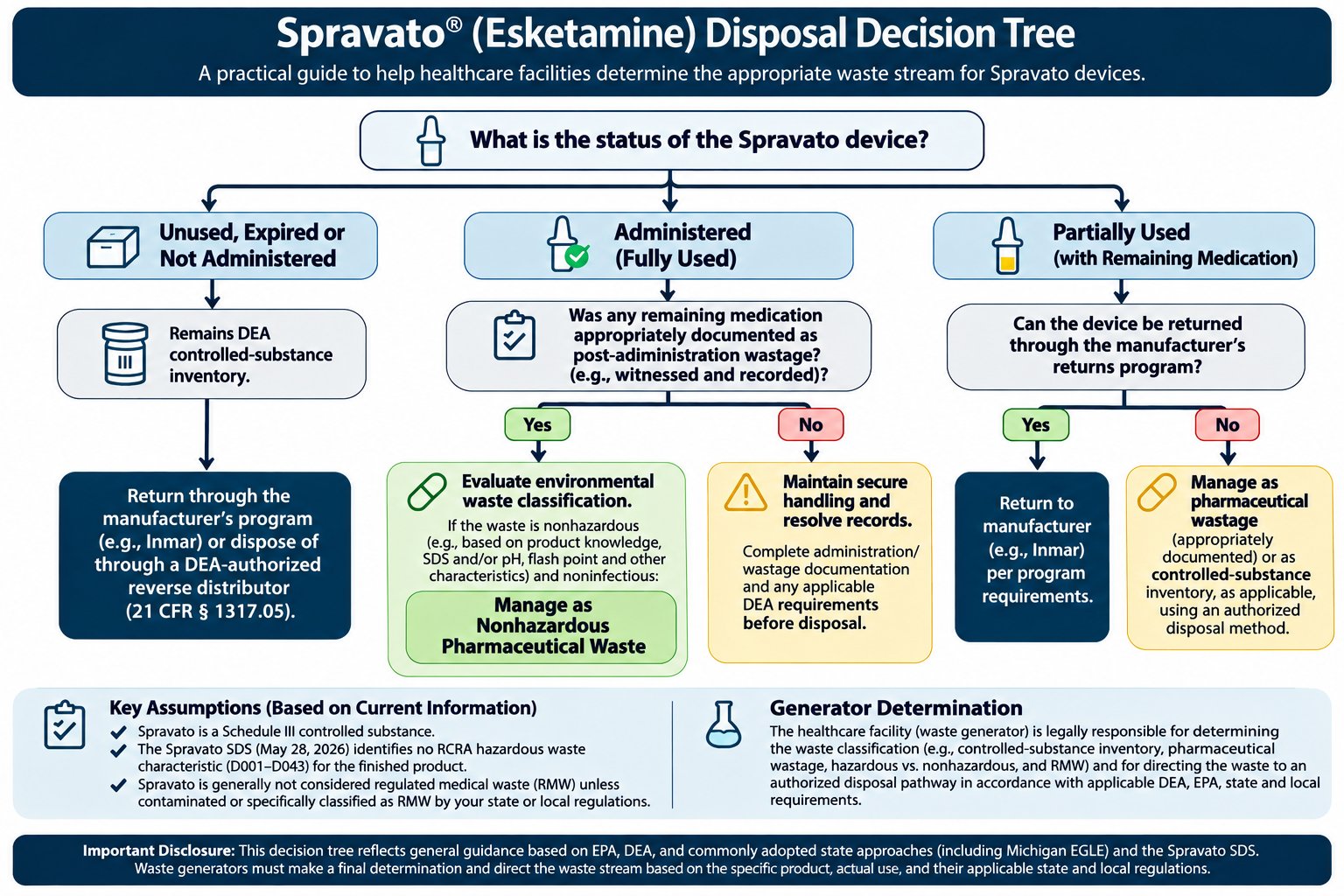
Spravato (esketamine) is a Schedule III controlled substance. Healthcare facilities must properly manage used, partially used, unused and expired nasal spray devices—but does that mean Spravato belongs in a red regulated medical waste (RMW) container?
Generally, no. A properly administered Spravato device does not meet the typical definition of regulated medical waste. Instead, healthcare providers should evaluate the medication and device under applicable controlled-substance and pharmaceutical waste regulations.
Johnson & Johnson's disposal instructions refer to used Spravato devices as "medical waste." However, the EPA, CDC and many state regulatory agencies distinguish pharmaceutical waste from regulated infectious medical waste.
Understanding that distinction helps healthcare facilities select the proper disposal method, avoid unnecessary disposal costs and maintain regulatory compliance.
Is Spravato Considered Regulated Medical Waste?
Typically, no. A normally used Spravato device does not inherently qualify as regulated medical waste.
The Environmental Protection Agency (EPA) generally describes medical waste as healthcare waste potentially contaminated with blood, bodily fluids or other infectious materials.
Common categories include:
- Blood and blood-contaminated materials
- Needles and other sharps
- Pathological waste
- Cultures and stocks of infectious agents
- Certain infectious laboratory wastes
Spravato is administered intranasally. The device does not puncture the patient's skin, and normal administration does not inherently produce blood-contaminated or infectious waste.
Simply administering medication does not make the resulting device RMW.
Important: The EPA does not maintain a single nationally binding definition of regulated medical waste. Individual states establish their own definitions and disposal requirements. A state's classification or an unusual contamination event may create additional obligations.
Why Does Johnson & Johnson Call Spravato "Medical Waste"?
Johnson & Johnson's official disposal instructions state that used Spravato devices should be managed as medical waste, following facility procedures for Schedule III drug products and applicable regulations.
This terminology can be confusing.
Healthcare waste is a broad term covering materials discarded by healthcare facilities. Regulated medical waste refers to a more specific, legally defined waste stream.
Johnson & Johnson appears to use "medical waste" broadly without explaining why a normally administered nasal spray device would meet the definition of infectious RMW.
The distinction matters because red medical waste containers are generally intended for infectious or otherwise regulated medical waste—not automatically for discarded pharmaceuticals.
The FDA-approved Spravato prescribing information separately directs facilities to dispose of used devices according to their procedures for Schedule III drug products and applicable laws.
The practical approach is to evaluate Spravato as a controlled pharmaceutical first, then determine whether any additional regulated medical waste requirements apply.
How to Dispose of Fully Used Spravato Nasal Spray Devices
A fully administered Spravato device should be managed according to the manufacturer's Schedule III handling instructions, applicable pharmaceutical waste regulations and the facility's documented disposal procedures.
Healthcare providers should:
- Document administration. Maintain required medication administration and controlled-substance accountability records.
- Secure discarded devices. Prevent unauthorized access, diversion or recovery of residual medication.
- Determine the appropriate waste classification. Distinguish an administered, potentially empty delivery device from pharmaceutical wastage or unused controlled-substance inventory.
- Use an appropriate disposal pathway. Select a waste management service or receiving facility authorized for the material and applicable regulatory requirements.
Does Residual Medication Remain DEA-Controlled After Administration?
The DEA distinguishes controlled-substance inventory from pharmaceutical wastage.
Pharmaceutical wastage includes controlled medication remaining in a vial, syringe, tube, transdermal patch or similar device after administration when that remaining medication cannot or will not be used.
Under the DEA Practitioner's Manual, pharmaceutical wastage must not be deposited into ordinary consumer drug take-back receptacles.
Instead, practitioners must document its destruction in accordance with 21 CFR § 1304.21(e) and comply with applicable federal, state and local requirements.
Residual medication does not become unrestricted simply because the prescribed dose was administered.
However, pharmaceutical wastage does not necessarily require the same inventory-disposal procedures used for expired or unused controlled medications.
How Michigan EGLE Classifies Used Controlled-Substance Waste
Michigan's Department of Environment, Great Lakes, and Energy (EGLE) provides particularly useful guidance on this issue.
EGLE distinguishes between controlled-substance inventory, documented pharmaceutical wastage and empty pharmaceutical containers.
Documented pharmaceutical wastage
EGLE explains that leftover, unadministered partial doses of controlled substances should be witnessed, documented and managed in a manner that prevents diversion.
Once the post-administration pharmaceutical wastage has been properly documented and collected, EGLE explains that the collected wastage is no longer regulated by DEA as controlled-substance inventory.
However, the collected waste remains subject to environmental waste regulations.
If the generator establishes that the waste is nonhazardous and noninfectious, an appropriate nonhazardous pharmaceutical waste disposal process may be used.
Fully administered and empty pharmaceutical devices
EGLE's June 2025 guidance also addresses empty pharmaceutical delivery devices.
Under applicable hazardous waste pharmaceutical rules, certain unit-dose delivery devices can qualify as RCRA-empty when their contents have been removed using normally employed practices.
An empty container that satisfies the applicable criteria may be managed outside the hazardous pharmaceutical waste stream, subject to other applicable requirements.
EGLE advises against placing empty pharmaceutical containers into sharps containers or treating them as medical waste solely because they previously contained medication.
For Spravato, facilities must also observe manufacturer-specific Schedule III handling instructions.
Source: Michigan EGLE — Handling Unwanted Pharmaceuticals and Pharmaceutical Containers
How to Dispose of Partially Used Spravato Devices
A partially used Spravato device may contain medication that was not administered.
Johnson & Johnson provides a designated returns program for unused and partially used devices when a healthcare facility is not equipped to dispose of them.
The recommended approach is:
- Use the manufacturer-authorized returns program when the product qualifies.
- If remaining medication constitutes pharmaceutical wastage after administration, follow applicable wastage documentation, security and environmental disposal requirements.
- If the product remains controlled-substance inventory, use a disposal or return process authorized for that inventory.
Do not assume that disposal in a standard red medical waste container satisfies the requirements for either category.
How to Dispose of Unused or Expired Spravato
Unused or expired Spravato generally remains controlled-substance inventory until properly returned, transferred or destroyed.
Option 1: Return eligible medication
Contact the dispensing pharmacy or manufacturer-authorized returns processor.
Johnson & Johnson identifies Inmar as its returns processor.
Option 2: Arrange authorized controlled-substance destruction
When a return is unavailable, a healthcare facility may transfer eligible inventory to a DEA-registered reverse distributor or use another destruction method permitted under 21 CFR § 1317.05.
Unlike documented pharmaceutical wastage, unused controlled-substance inventory remains subject to the DEA's inventory disposal requirements.
Ordinary consumer take-back receptacles and mail-back envelopes must not be used to dispose of practitioner inventory.
Can Spravato Go Into a Red Biohazard or Sharps Container?
Generally, a properly used Spravato nasal spray device does not belong in the infectious RMW stream solely because it was administered to a patient.
The device is not inherently a sharp and does not ordinarily create infectious waste through its intended use.
Most red medical waste is treated to address infectious hazards. Conventional medical waste treatment, such as autoclaving, does not necessarily provide appropriate treatment or destruction of pharmaceutical residues.
When a device also contains infectious contamination or independently qualifies as regulated medical waste, it may require management under more than one regulatory waste category.
Such waste must be directed to a facility authorized to accept and treat all applicable waste classifications.
For unusual contamination or mixed-waste situations, talk to an expert before arranging disposal.
Is Spravato Considered RCRA Hazardous Pharmaceutical Waste?
Based on Johnson & Johnson's published Safety Data Sheet (SDS), no specific RCRA hazardous waste characteristic has been identified for the finished Spravato nasal spray formulation.
This suggests Spravato may qualify as nonhazardous pharmaceutical waste when discarded, provided the generator completes and documents an accurate hazardous waste determination.
Johnson & Johnson's Spravato Safety Data Sheet, revised May 28, 2026, provides the following information:
- Ignitability (D001): The SDS does not classify Spravato as flammable, although a finished-product flash point is not provided.
- Corrosivity (D002): No corrosive classification is identified, but the finished formulation's pH is not reported.
- Reactivity (D003): The SDS states that the product is stable under normal conditions and identifies no reasonably foreseeable reactivity.
- Toxicity (D004–D043): The SDS does not identify a RCRA toxicity-characteristic waste code or provide TCLP results establishing that a regulatory threshold is exceeded.
The SDS does identify a chronic aquatic environmental hazard. However, an aquatic hazard classification under the Globally Harmonized System (GHS) is not equivalent to a RCRA hazardous waste characteristic.
Does This Mean Spravato Is Nonhazardous Waste?
The available SDS information supports a preliminary nonhazardous assessment, but it does not establish a final RCRA waste determination by itself.
Under 40 CFR § 262.11, the generator is responsible for determining whether its waste is listed or exhibits a hazardous waste characteristic.
The generator may use reliable product knowledge, manufacturer information or analytical testing to make that determination.
For Spravato, additional information may be necessary to establish:
- The finished formulation's pH, particularly for the corrosivity characteristic
- Its flash point or other reliable information concerning ignitability
- Whether any toxicity-characteristic contaminants are present at regulated levels
- Whether any applicable hazardous waste listing or state-specific criteria apply
Laboratory testing is not automatically required when sufficient reliable knowledge already supports the determination. However, testing may be needed if existing information is insufficient.
If the generator establishes that discarded Spravato is not RCRA hazardous, it should not be classified as hazardous waste solely because it is a prescription pharmaceutical or DEA Schedule III controlled substance.
In that situation, federal hazardous waste pharmaceutical management requirements under 40 CFR Part 266 Subpart P generally would not apply to Spravato as a hazardous waste pharmaceutical. Other provisions of that rule, including applicable sewer-disposal restrictions, may still apply.
DEA controlled-substance requirements and state-specific pharmaceutical waste rules must be considered separately.
What This Means for Disposal
For properly documented post-administration Spravato wastage that has been determined to be non-RCRA-hazardous and noninfectious, nonhazardous pharmaceutical waste management may be an appropriate disposal pathway, subject to the remaining federal, state and manufacturer requirements.
The SDS supports this evaluation, but it does not replace the generating facility's legal responsibility to substantiate its waste classification.
Who Is Legally Responsible for Determining the Correct Waste Stream?
The healthcare facility generating the waste is responsible for properly identifying, characterizing and managing its waste in accordance with applicable regulations.
That responsibility does not automatically transfer to a medical waste transporter or disposal contractor when the facility hires a waste management company.
Under EPA hazardous waste generator requirements, including 40 CFR § 262.11, generators must make accurate hazardous waste determinations.
In practical terms, the generating facility is responsible for:
- Properly characterizing and classifying its waste
- Determining which regulatory requirements apply
- Segregating differently regulated waste streams
- Using appropriate packaging, labeling and storage procedures
- Selecting authorized transporters and receiving facilities
- Maintaining required documentation and shipment records
A waste management provider may assist with these responsibilities, but hiring a contractor does not eliminate the generator's legal obligations.
Transporters and disposal facilities also have independent regulatory responsibilities concerning the waste they transport or accept.
The generator must accurately identify the waste and ensure it is directed to an authorized disposal pathway.
What Does the DEA Require for Spravato Disposal?
Spravato contains esketamine, a Schedule III controlled substance.
The DEA distinguishes between two major disposal situations.
Controlled-substance inventory: Unused, expired or unwanted inventory is generally managed under 21 CFR § 1317.05. Authorized methods include transfer to DEA-registered reverse distributors and certain other permitted destruction procedures.
Pharmaceutical wastage: Leftover medication after patient administration is handled under applicable wastage documentation and destruction requirements. It is not eligible for disposal through ordinary consumer collection receptacles.
Healthcare facilities should maintain policies distinguishing administered medication and residual wastage from medication that remains in inventory.
Spravato Disposal Services: How Superior Medical Waste Disposal Can Help
Healthcare facilities administering Spravato need a disposal program that correctly distinguishes administered pharmaceutical wastage, empty drug-delivery devices and unused controlled-substance inventory.
Superior Medical Waste Disposal assists healthcare organizations in evaluating pharmaceutical waste management needs and identifying appropriate disposal solutions.
Superior offers DEA-compliant mail-back pouches for eligible controlled-substance collection applications. Acceptance depends on the specific program's authorizations, waste source and material type. Consumer drug take-back pouches are not authorized for routine disposal of practitioner inventory or pharmaceutical wastage.
For facilities handling Spravato or other esketamine products, Superior can help identify appropriate handling, collection and authorized disposal arrangements.
Need help determining the proper disposal method for your facility? Talk to an Expert at Superior Medical Waste Disposal.
Frequently Asked Questions
Is Spravato regulated medical waste?
Generally, no. A normally used nasal spray device does not inherently meet typical infectious RMW definitions. Applicable state rules and unusual contamination circumstances may alter the classification.
Is Spravato a controlled substance?
Yes. Esketamine is a Schedule III controlled substance.
Is Spravato RCRA hazardous waste?
Johnson & Johnson's May 2026 SDS does not identify a specific RCRA hazardous waste characteristic for the finished product. This supports a preliminary nonhazardous assessment, but the generator must complete an accurate hazardous waste determination.
Does a fully administered device containing drug residue remain subject to DEA requirements?
Residual controlled medication may constitute pharmaceutical wastage. DEA documentation requirements apply, but pharmaceutical wastage is distinguished from unused controlled-substance inventory.
What does Michigan EGLE say about pharmaceutical wastage?
EGLE explains that properly witnessed and documented pharmaceutical wastage following administration is no longer regulated by DEA as inventory, but remains subject to applicable environmental waste regulations.
Are empty pharmaceutical delivery devices regulated medical waste in Michigan?
Generally, no. EGLE advises against managing empty pharmaceutical containers as medical waste solely because they previously contained medication. Other applicable requirements, including product-specific controlled-substance instructions, still need to be satisfied.
Can expired Spravato be returned?
Yes, subject to eligibility under the manufacturer, pharmacy or distributor returns program. Otherwise, unused inventory requires an authorized controlled-substance disposal process.
Who determines whether Spravato is RMW or pharmaceutical waste?
The waste generator is responsible for making applicable waste determinations and ensuring the waste is correctly managed. Authorized transporters and receiving facilities must also comply with their own regulatory requirements.
Official Regulatory Resources
- Johnson & Johnson — Spravato Safety Data Sheet, May 2026
- EPA — Medical Waste
- EPA — Hazardous Waste Characteristics
- EPA — Hazardous Waste Determination, 40 CFR § 262.11
- DEA — Practitioner's Manual
- DEA — Controlled Substance Disposal Regulations
- Michigan EGLE — National Rules for Healthcare Pharmaceutical Disposal
- Michigan EGLE — Pharmaceutical Container Guidance
- Johnson & Johnson — Return or Disposal of Spravato
This article provides general regulatory information. Federal, state and local requirements, device conditions and facility-specific procedures may affect the appropriate waste classification and disposal method. Waste generators are responsible for complying with applicable regulations.