
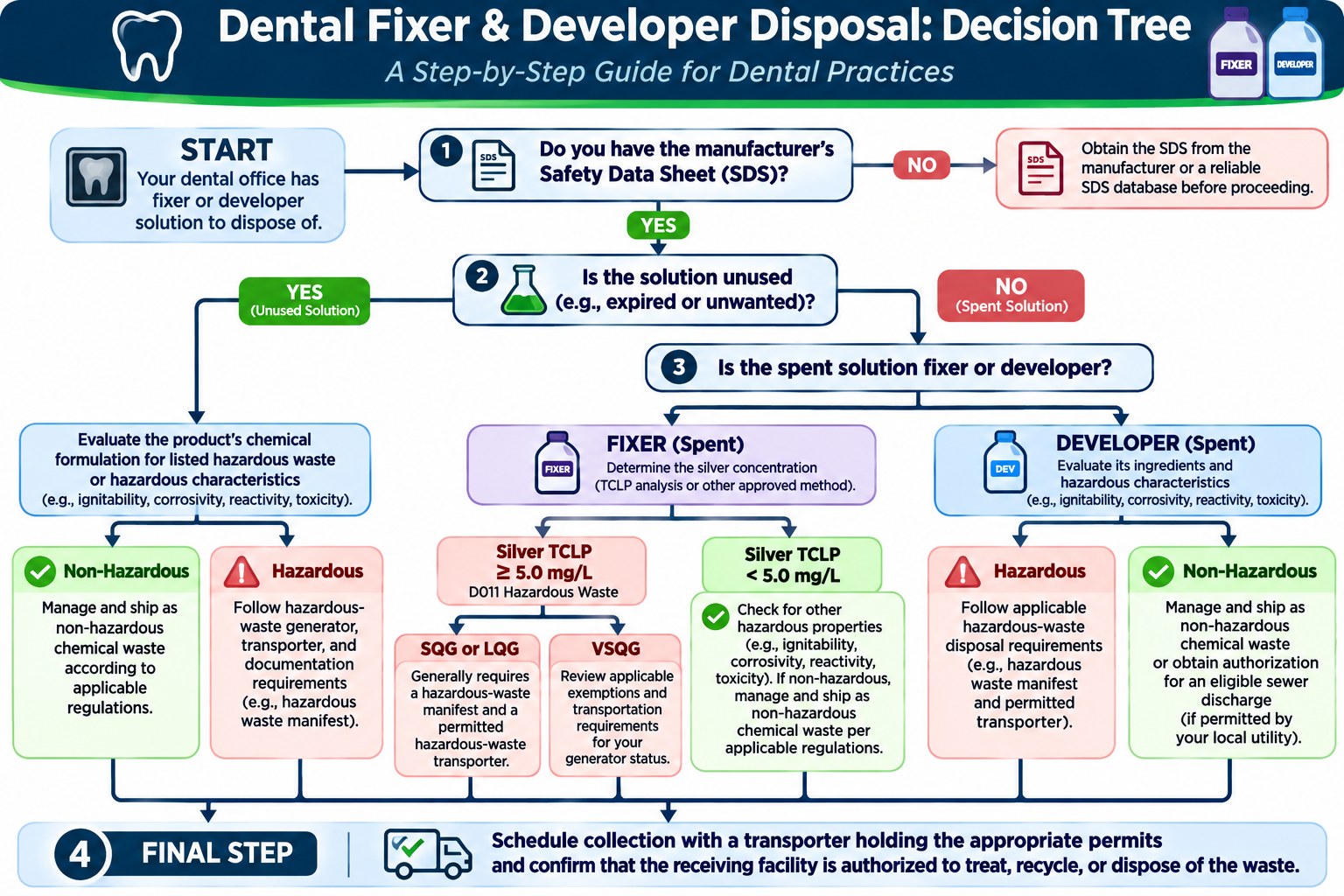
A Step-by-Step Guide for Dental Offices in Michigan
Dental practices that still use traditional X-ray processing equipment generate chemical waste from photographic fixer and developer solutions. While these chemicals may look harmless, improper disposal can violate state and federal environmental regulations.
One of the biggest concerns is spent dental fixer containing silver, which may qualify as hazardous waste under EPA regulations.
Before scheduling a waste pickup, dental practices must identify their chemicals, determine whether they are hazardous, and arrange appropriate transportation and disposal.
Here's how to do it.
Step 1: Understand Your Responsibility as a Waste Generator
Under EPA regulations, a dental practice that produces or discards chemical waste is considered a waste generator.
This means your office is responsible for identifying the waste it produces and determining whether that waste is hazardous.
You cannot rely solely on your waste disposal provider to make this determination.
As a generator, your responsibilities include:
- Identifying the chemical waste produced by your practice.
- Determining whether the chemicals are hazardous or non-hazardous.
- Maintaining documentation supporting the waste classification.
- Storing and labeling waste appropriately.
- Arranging transportation and treatment through properly authorized providers.
Your dental practice remains responsible for properly managing its waste even after hiring a disposal company.
Step 2: Obtain the Safety Data Sheet (SDS)
Before disposing of dental fixer or developer, locate the Safety Data Sheet (SDS), formerly known as an MSDS, for each chemical.
You can typically obtain an SDS directly from the product manufacturer or supplier.
If you do not have a copy, search online using the manufacturer's name, product name, and the words "Safety Data Sheet."
For example:
Air Techniques PERI-PRO Fixer Safety Data Sheet
Pay particular attention to:
- Section 2: Hazard identification
- Section 3: Chemical composition and ingredients
- Section 9: Physical and chemical properties
- Section 13: Disposal considerations
- Section 14: Transportation information
An SDS helps identify a product's original chemical properties. However, it does not necessarily establish whether the solution becomes hazardous after use.
Important: A chemical marked "Not regulated for transportation" on its SDS may still become a regulated hazardous waste after being used.
Step 3: Determine Whether the Fixer or Developer Has Been Used
The next step is to identify whether your chemical solution is unused or spent.
Unused Dental Fixer and Developer
Unused, expired, or unwanted solutions may be non-hazardous depending on their chemical composition and characteristics.
For example, certain unused photographic fixer and developer products have manufacturer SDS documentation showing that they are not regulated as hazardous materials for transportation.
However, each product must be evaluated individually before disposal.
Spent Dental Fixer
Spent fixer is solution that has already been used during dental X-ray film processing.
During development, the fixer removes silver compounds from photographic film. As a result, spent fixer may contain significant concentrations of silver.
This is important because silver is regulated under EPA hazardous-waste code D011.
Spent fixer must be evaluated for hazardous silver concentrations before selecting a disposal method.
Spent Dental Developer
Spent developer generally presents a different disposal concern.
Developer solutions can contain ingredients such as hydroquinone and alkaline chemicals. Depending on the formulation and use, they may require hazardous-waste evaluation.
Unlike spent fixer, developer does not normally accumulate significant amounts of silver during proper X-ray processing.
Never mix fixer and developer solutions. Mixing can complicate waste classification, treatment, and disposal.
Step 4: Determine Whether Spent Fixer Is D011 Hazardous Waste
The EPA regulates silver under hazardous-waste code D011.
The federal threshold is:
5.0 milligrams per liter (mg/L) of silver using the Toxicity Characteristic Leaching Procedure (TCLP).
| TCLP silver result | Classification |
|---|---|
| Below 5.0 mg/L | Not D011 based on silver |
| 5.0 mg/L or higher | D011 hazardous waste |
A solution below the silver threshold must still be evaluated for other hazardous-waste characteristics.
How Does a Dental Office Determine the Silver Concentration?
A dental office can establish its waste classification using reliable knowledge of its process and materials or appropriate laboratory analysis.
When testing is necessary, a qualified laboratory can perform the EPA-approved TCLP analysis.
Do not confuse total silver concentration with TCLP silver results. These measurements are not interchangeable.
If your practice cannot establish whether the waste is hazardous, contact a qualified waste management provider before arranging disposal.
Step 5: Determine Whether an EPA Manifest or Shipping Document Is Required
Once the chemical waste has been characterized, your dental office can determine which transportation documents apply.
In Michigan, these generally fall into two categories.
Option A: Hazardous Waste — EPA Uniform Hazardous Waste Manifest
If spent fixer qualifies as D011 hazardous waste, small and large quantity generators generally must use:
- An EPA Uniform Hazardous Waste Manifest.
- A permitted and registered hazardous-waste transporter.
- A receiving facility authorized to accept the hazardous waste.
- Appropriate packaging, labeling, and applicable DOT shipping documentation.
Michigan also allows certain qualifying silver-bearing wastes to be managed under alternative precious-metals recovery standards. These have their own requirements.
Very small quantity generators (VSQGs) may qualify for a manifest exemption when all applicable conditions are satisfied. Michigan provides specific transportation options for these generators, so a D011 classification does not automatically mean every dental practice needs a manifest.
Option B: Non-Hazardous Liquid Waste — Shipping Document or Bill of Lading
If the solution is determined to be non-hazardous, it may fall under Michigan's Part 121 Liquid Industrial By-Products regulations.
These shipments generally require:
- A shipping document, such as a compliant bill of lading.
- A permitted and registered liquid industrial by-product transporter.
- A designated facility authorized to receive the waste.
- Appropriate containers and identification of their contents.
A Uniform Hazardous Waste Manifest is generally not required for non-hazardous liquid industrial by-products.
A properly completed shipping document should identify the generator, transporter, waste type, volume, shipment date, and designated receiving facility information.
Step 6: Arrange Proper Disposal or Recycling
After the waste has been classified, the dental practice can schedule transportation to an appropriate facility.
Depending on the waste characteristics, acceptable management options may include:
For hazardous spent fixer:
- Authorized hazardous-waste treatment or disposal.
- Silver recovery or reclamation under applicable hazardous-waste or precious-metals recovery requirements.
For non-hazardous liquid fixer or developer:
- Authorized liquid industrial by-product treatment.
- Appropriate recycling or chemical processing facilities.
Some used developer solutions may be eligible for discharge to a municipal sanitary sewer if the local publicly owned treatment works (POTW) expressly allows it.
Do not assume an SDS statement permitting sewer disposal authorizes your dental office to pour chemicals down the drain.
Michigan also has separate requirements for dental operational wastewater, particularly for practices using onsite septic systems.
Common Questions About Dental Fixer and Developer Disposal
Is dental fixer considered hazardous waste?
Unused dental fixer is not necessarily hazardous. However, spent fixer can contain enough silver to qualify as D011 hazardous waste.
Is dental developer hazardous waste?
Not automatically. The classification depends on the product's chemical composition, whether it has been used, and whether it meets any hazardous-waste criteria.
Can dental offices pour fixer down the drain?
Dental offices should not discharge spent fixer into drains without determining its regulatory status and obtaining applicable wastewater discharge authorization. Silver contamination can make the solution unsuitable for sewer disposal.
Does every dental office need an EPA hazardous-waste manifest?
No. The requirement depends on the waste classification, generator category, and applicable state and federal regulations.
For non-hazardous liquids transported under Michigan Part 121, a compliant shipping document or bill of lading generally replaces the hazardous-waste manifest.
Does a dental office need an EPA identification number?
Some hazardous-waste generator categories require an EPA Site Identification Number. Very small quantity generators may qualify for exemptions. Michigan also has Site ID requirements for certain liquid industrial by-product activities and transporters.
The appropriate requirements should be confirmed before the first shipment.
Need Dental Fixer or Developer Disposal in Michigan?
Superior Medical Waste Disposal, LLC helps Michigan dental practices coordinate appropriate waste collection, transportation, and disposal services.
Whether your office has unused dental processing chemicals, spent fixer containing silver, or non-hazardous developer solutions, proper waste identification is the first step toward compliant disposal.
Before requesting a pickup, gather:
- Your chemical's manufacturer and product name.
- The applicable Safety Data Sheet.
- Whether the solution is unused or spent.
- Any available waste characterization or silver testing results.
- The approximate number of gallons requiring disposal.
Contact Superior Medical Waste Disposal to discuss the appropriate collection and disposal options for your dental practice.
Disclaimer: This article provides general educational information with a Michigan regulatory focus. Individual waste streams must be evaluated based on their actual characteristics, generator status, and applicable federal, state, and local requirements.